
Key Person Risk Diagnostic
Find out what breaks in your business the moment you leave
12 followers
Find out what breaks in your business the moment you leave
12 followers
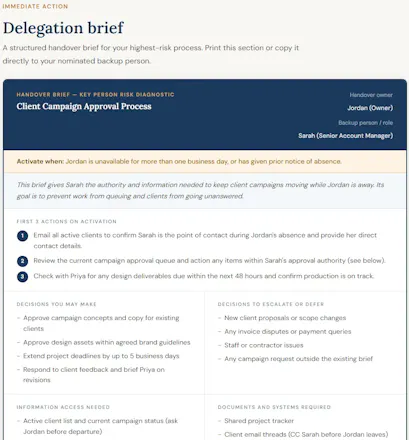
Most small business owners don't know they're a single point of failure until something breaks. The Key Person Risk Diagnostic analyses your documents, emails, and SOPs and returns a ranked report naming the specific people, processes, and decisions that stop working the moment you step away. No generic advice. Named risks, named processes, a delegation brief, and a 7-day stabilisation plan. One payment. No account needed. Delivered within minutes.


Payment Required
Launch Team / Built With


Dropbox SignSimple, secure eSignatures for the way your team works.
Promoted
"As a solo founder this hits close to home. I am the single point of failure. The 7-day stabilization plan angle is smart because most tools just tell you the problem without giving you a way out. What kind of documents does it need to give useful results — SOPs only, or does it work with something lighter like a Notion workspace?"
@a_kay2 Thanks, and sorry for the delayed reply.
You definitely do not need polished SOPs. Plain text can work on its own, especially if you can describe how the business runs, who owns what, where the founder is involved, and what would break if that person was unavailable.
That said, plain text works even better when used in conjunction with relevant uploaded documents, such as SOPs, checklists, role notes, handover notes, process maps, recurring task lists, Google Docs, exported Notion pages, copied Notion content, or rough internal notes.
There is no live Notion integration. The diagnostic works from the information you provide or upload.
The goal is not to judge how neat the documentation is. It is to turn what already exists, even if it is messy, into a practical risk view and a 7-day stabilisation plan.
A sample report can be found over here:
https://processlode.com.au/key-person-risk/sample-report/