Solveaux is a community platform for innovators, engineers, researchers, founders, and builders to document reasoning, share technical knowledge, discuss research, collaborate on ideas, and turn concepts into breakthroughs.
No reviews yetBe the first to leave a review for Solveaux
Maker
📌
Hi Product Hunt! 👋
I'm excited to introduce Solveaux — an Organizational Intelligence Platform that helps individuals and teams capture, organize, and reuse knowledge, decisions, and reasoning.
Every day, people solve complex problems, make important decisions, run experiments, and discover new ideas — but the thinking behind those outcomes is often lost.
Most platforms focus on the final result: a finished project, a published paper, or a completed solution. The journey, reasoning, failures, and lessons learned usually disappear into private notes, scattered documents, or conversations.
Solveaux is built to preserve that intelligence.
With Solveaux, you can:
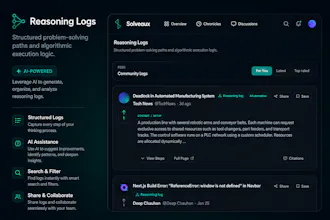
🧠 Capture Reasoning Logs — document your thought process, experiments, problem-solving approaches, and decision-making.
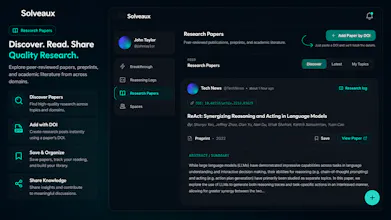
🔬 Share Research & Insights — publish research papers, technical explorations, findings, and discoveries.
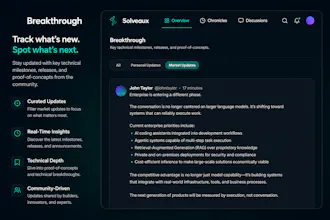
🚀 Document Breakthroughs & Progress — share innovations, projects, launches, and important updates.
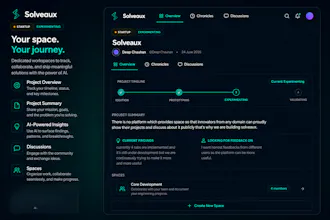
🪐 Create Spaces — build focused knowledge environments for personal learning, teams, technologies, research areas, startups, and communities.
Solveaux transforms knowledge from static information into a living intelligence layer — making ideas, experiences, and reasoning searchable, understandable, and reusable.
Whether you're an individual learning a new skill, a developer solving engineering challenges, a researcher exploring new ideas, or a team building products, Solveaux helps you preserve and share the intelligence behind your work.
I'd love your feedback!
What would make Solveaux part of your workflow?
What features would help you turn your knowledge into reusable intelligence?
Thanks for exploring Solveaux! ❤️
Report
How does this compare to just using a shared doc or Notion for capturing and discussing technical ideas, what makes it worth switching for a small team?
Report
Maker
@anlpiyr That's a fair question. The comment you're replying to describes an earlier version of Solveaux, and the product has evolved quite a bit since then.
Today, Solveaux is more than a place to write technical notes. It's a platform built around engineering knowledge, discussions, AI, research, and innovation.
Unlike a shared doc or Notion, content on Solveaux isn't meant to stay isolated within one workspace. Teams and individuals can organize engineering knowledge, discuss ideas, publish research, share updates, and build a searchable knowledge base that AI can understand and build upon.
Notion is excellent for documentation and internal collaboration, and we're not trying to replace it. Solveaux is focused on creating an engineering-first knowledge network where ideas, reasoning, research, and technical discussions become discoverable, reusable, and valuable beyond a single document.
The product is still evolving, and feedback like this helps shape where we take it next.
Report
How does Solveaux handle version control when an idea branches into multiple directions? Curious if it keeps the original reasoning intact while letting collaborators explore different paths.
Report
Maker
@selahattinkucx Right now, the original reasoning always stays intact. People can discuss it, build on it, and share different ideas without changing the original. If you want to preserve previous work while exploring new ideas, you can currently use Spaces, which let you continue your work while keeping earlier progress organized
A branching or "fork" feature is something I'm considering, where anyone could create their own version of a reasoning log while keeping a link to the original. I think that would make collaboration much more interesting.
I'd love to hear how you'd expect something like that to work.
Report
How does it actually differ from something like Notion or Obsidian when it comes to documenting engineering reasoning day to day?
Report
Maker
@esilateum It's actually quite different from Notion or Obsidian.
With Solveaux, you can document a problem, your solution, and the reasoning behind it. You can also share project breakthroughs, engineering updates, or market insights.
You can publish research by simply providing a DOI, and you can join or create Spaces around whatever you're building to collaborate and share progress.
Report
Finally tried Solveaux after seeing it mentioned a few times. The timeline view for a technical thread actually made a long debugging conversation make sense afterward, which is more than I expected from a notes app.
Hi Product Hunt! 👋
I'm excited to introduce Solveaux — an Organizational Intelligence Platform that helps individuals and teams capture, organize, and reuse knowledge, decisions, and reasoning.
Every day, people solve complex problems, make important decisions, run experiments, and discover new ideas — but the thinking behind those outcomes is often lost.
Most platforms focus on the final result: a finished project, a published paper, or a completed solution. The journey, reasoning, failures, and lessons learned usually disappear into private notes, scattered documents, or conversations.
Solveaux is built to preserve that intelligence.
With Solveaux, you can:
🧠 Capture Reasoning Logs — document your thought process, experiments, problem-solving approaches, and decision-making.
🔬 Share Research & Insights — publish research papers, technical explorations, findings, and discoveries.
🚀 Document Breakthroughs & Progress — share innovations, projects, launches, and important updates.
🪐 Create Spaces — build focused knowledge environments for personal learning, teams, technologies, research areas, startups, and communities.
Solveaux transforms knowledge from static information into a living intelligence layer — making ideas, experiences, and reasoning searchable, understandable, and reusable.
Whether you're an individual learning a new skill, a developer solving engineering challenges, a researcher exploring new ideas, or a team building products, Solveaux helps you preserve and share the intelligence behind your work.
I'd love your feedback!
What would make Solveaux part of your workflow?
What features would help you turn your knowledge into reusable intelligence?
Thanks for exploring Solveaux! ❤️
How does this compare to just using a shared doc or Notion for capturing and discussing technical ideas, what makes it worth switching for a small team?
How does Solveaux handle version control when an idea branches into multiple directions? Curious if it keeps the original reasoning intact while letting collaborators explore different paths.
@selahattinkucx Right now, the original reasoning always stays intact. People can discuss it, build on it, and share different ideas without changing the original.
If you want to preserve previous work while exploring new ideas, you can currently use Spaces, which let you continue your work while keeping earlier progress organized
A branching or "fork" feature is something I'm considering, where anyone could create their own version of a reasoning log while keeping a link to the original. I think that would make collaboration much more interesting.
I'd love to hear how you'd expect something like that to work.
How does it actually differ from something like Notion or Obsidian when it comes to documenting engineering reasoning day to day?
@esilateum It's actually quite different from Notion or Obsidian.
With Solveaux, you can document a problem, your solution, and the reasoning behind it. You can also share project breakthroughs, engineering updates, or market insights.
You can publish research by simply providing a DOI, and you can join or create Spaces around whatever you're building to collaborate and share progress.
Finally tried Solveaux after seeing it mentioned a few times. The timeline view for a technical thread actually made a long debugging conversation make sense afterward, which is more than I expected from a notes app.