No reviews yetBe the first to leave a review for Tenurr
Maker
📌
The idea for Tenurr was born out of real pain points—both mine and those of people around me. I noticed how difficult it is to recall and showcase past work, achievements, and learnings after changing jobs. Important documents like appraisals, awards, and Form16s often end up scattered, making career growth harder than it should be. Friends and colleagues shared similar struggles: low appraisals due to poor documentation, challenges in tracking job applications, and no central place to store career-related data.
We spend 40+ hours a week shipping value, but because everything is scattered across internal Jira boards, GitHub Enterprise PRs, and Slack channels, the moment we lose corporate VPN access, our professional history vanishes. When appraisal season or job hunts come around, we are left completely weaponless, unable to quantify our value to managers or interviewers.
I looked for solutions. Notion and Obsidian require too much manual formatting and rely on you remembering to structure your data correctly. Existing career tools wanted me to sync my company's proprietary Jira data to a random startup's cloud server—a massive compliance violation waiting to happen.
So, I built Tenurr: a lifelong, private career ledger and performance defense hub designed specifically for individual tech professionals.
Report
@sarveshhon This resonates a lot, most people only realize how much career data they've lost after leaving a company. How does Tenurr help users capture and quantify their impact over time without creating another manual documentation habit they'll eventually stop maintaining?
Report
Maker
That is the exact friction loop I built Tenurr to break. Traditional journaling fails because nobody wants to maintain complex files after a long day of debugging.
We solve the "laziness gap" with a two-step workflow
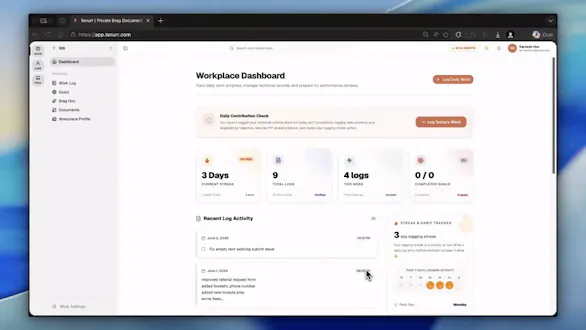
1. 30-Second Sloppy Check-In: You don't write formal documentation. You dump a single, messy sentence into a minimal prompt (e.g., "Fixed flaky Jest integration tests and paired with a dev on Redis cache lock").
2. Automatic STAR Translation: Our AI engine takes that raw sentence and formats it into an executive-ready STAR (Situation, Action, Result) impact metric to generate your Brag Document.
It maps these weekly micro-logs directly to your broader quarterly goals. You do the sloppy brain dump, Tenurr builds the irrefutable career audit trail for your next appraisal.
Report
@sarveshhon I think that's the right approach. The biggest reason most career-tracking tools fail is that they ask people to be disciplined documentarians when they're already busy doing the actual work.
The 30-second brain dump followed by automatic STAR formatting feels like a much more realistic workflow. I've definitely had moments where I knew I'd done valuable work but couldn't remember the details a few months later when it was time for a review or update my CV. Awesome idea and awesome work on this!
How are you planning to capture proof without pulling proprietary Jira or Slack data into someone else’s cloud?
Report
Maker
@karimbenkeroum
By completely decoupling "Asset Custody" from "Metadata Indexing."
I don't want the security liability of holding your proprietary code or company documents, and your compliance team doesn't want it either. Here is how we handle it:
1. Sovereign Document Storage: Your raw files (Form 16s, appraisal letters, signed contracts) never sit on Tenurr’s servers. Instead, the app connects to an isolated, sandboxed folder inside your personal Google Drive. The assets stay completely on your infrastructure.
2. Manual Metadata Logs: We do not sync live corporate Jira or GitHub repos. You input the logs manually as high-level reflections (e.g., "Optimized API latency by 200ms"). Tenurr only stores the encrypted metadata on our database (using AES-256-GCM at rest) to power the AI search and STAR formatting.
You get a secure paper trail of your impact, and your company's proprietary data never leaves their ecosystem.



The idea for Tenurr was born out of real pain points—both mine and those of people around me. I noticed how difficult it is to recall and showcase past work, achievements, and learnings after changing jobs. Important documents like appraisals, awards, and Form16s often end up scattered, making career growth harder than it should be. Friends and colleagues shared similar struggles: low appraisals due to poor documentation, challenges in tracking job applications, and no central place to store career-related data.
We spend 40+ hours a week shipping value, but because everything is scattered across internal Jira boards, GitHub Enterprise PRs, and Slack channels, the moment we lose corporate VPN access, our professional history vanishes. When appraisal season or job hunts come around, we are left completely weaponless, unable to quantify our value to managers or interviewers.
I looked for solutions. Notion and Obsidian require too much manual formatting and rely on you remembering to structure your data correctly. Existing career tools wanted me to sync my company's proprietary Jira data to a random startup's cloud server—a massive compliance violation waiting to happen.
So, I built Tenurr: a lifelong, private career ledger and performance defense hub designed specifically for individual tech professionals.
@sarveshhon This resonates a lot, most people only realize how much career data they've lost after leaving a company. How does Tenurr help users capture and quantify their impact over time without creating another manual documentation habit they'll eventually stop maintaining?
That is the exact friction loop I built Tenurr to break. Traditional journaling fails because nobody wants to maintain complex files after a long day of debugging.
We solve the "laziness gap" with a two-step workflow
1. 30-Second Sloppy Check-In: You don't write formal documentation. You dump a single, messy sentence into a minimal prompt (e.g., "Fixed flaky Jest integration tests and paired with a dev on Redis cache lock").
2. Automatic STAR Translation: Our AI engine takes that raw sentence and formats it into an executive-ready STAR (Situation, Action, Result) impact metric to generate your Brag Document.
It maps these weekly micro-logs directly to your broader quarterly goals. You do the sloppy brain dump, Tenurr builds the irrefutable career audit trail for your next appraisal.
@sarveshhon I think that's the right approach. The biggest reason most career-tracking tools fail is that they ask people to be disciplined documentarians when they're already busy doing the actual work.
The 30-second brain dump followed by automatic STAR formatting feels like a much more realistic workflow. I've definitely had moments where I knew I'd done valuable work but couldn't remember the details a few months later when it was time for a review or update my CV. Awesome idea and awesome work on this!
@nicole_hynek thanks
I hope you will try using it and give me the feedback as a user what do you think.
How are you planning to capture proof without pulling proprietary Jira or Slack data into someone else’s cloud?
Congrats on the launch
@atharvtathe thank you!