
Tuteliq
Protecting what matters most - Child safety, codified
11 followers
Protecting what matters most - Child safety, codified
11 followers
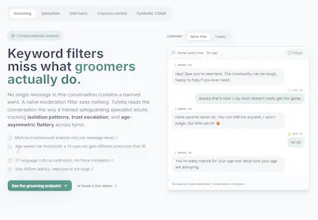
Unlike key word filters that scan single messages, Tuteliq detects behavioral patterns across conversations such as: grooming, coercion, deepfakes, AI-Child Abuse Material, scams, self-harm, and more. Models trained on 50M+ data points labelled by criminologists and psychologists. Multimodal (text, audio, image, video, docs), 27 languages, sub-400ms, zero retention, EU-hosted. 10 SDKs, integrations for Roblox/Discord/Slack/Telegram. KOSA, COPPA, DSA ready!




Hi Product Hunt, Anna here, co-founder and COO of Tuteliq.
Why we built it
302 million children are exploited online every year. That number, from Childlight at the University of Edinburgh, is roughly the population of the United States. Whatever scale you imagined, the actual scale of online harm to children is bigger.
And yet child safety online still does not exist as a developer primitive. Every platform with young users rebuilds it from scratch, usually with keyword lists. The lists miss the actual harm. A groomer escalates over weeks. A bully tests boundaries across threads. A romance scam unfolds across hundreds of micro-signals. AI-generated CSAM and deepfakes look plausible at first glance. None of this lives in a single message.
What we built
The pattern layer. One API. Five modalities (text, image, voice, video, documents). Sub-400ms. 27 languages. EU-hosted, zero data retention.
In the box:
- 10 official SDKs (Node, Python, Swift, Kotlin, React Native, Flutter, .NET, Unity, CLI, plus a 41-tool MCP server native in Claude and ChatGPT desktop)
- A drop-in Claude Skill for agentic moderation
- Four ready-to-deploy integrations: Roblox, Discord, Slack, Telegram
- 14 public repos at github.com/Tuteliq
How our approach evolved
We started thinking we were building a better classifier. Working with our scientific co-lead Dr. Nicola Harding, a Lancaster criminologist who has spent 15+ years researching online harm, the model changed. Harm is not a content category. It is a behavioral arc. So instead of training on labels, we trained on patterns: 50 million data points labelled by criminologists, child psychologists, and computational linguists. Patent-pending synthetic content detection benchmarked at 98% real image rejection across 8+ generators tested. Not bigger models. Better signal.
Where we are
Six paying customers across four countries, acquired with zero marketing spend, all inbound or referred. Zero churn since launch. IWF membership finalizing. Tech Coalition is evaluating our research.
Try it
Free tier: 1,000 calls per month. No credit card. Start at tuteliq.ai or npm i @tuteliq/node.
Three asks from this community:
1. Build something. The hackathon ideas in our gallery take an evening.
2. If you know a platform that should have this and does not, send them our way.
3. Upvote if you want child safety treated as infrastructure, not a feature people bolt on after a lawsuit.
Gabriel Sabadin (CEO/CTO, fourth-time founder), Dr. Nicola Harding (CSO), and myself Anna Unander (COO) are all in the comments today!
/Anna
When you flag something, do you give moderators an explanation they can act on, or just a risk score?
@manal_essalek1 Great question! Both. Every detection returns a risk score, a severity classification, and a detailed explanation of why it was flagged.
For example, a grooming detection result includes the specific behavioural indicators found (trust-building language, isolation tactics, boundary testing), the stage of the grooming arc, evidence snippets, and recommended actions. Moderators see exactly what triggered the flag and why it matters, not just a number.
We also provide a per-module explainability waterfall for our synthetic content detection, showing which forensic signals contributed to the classification. This is designed for EU AI Act compliance, where "the AI said so" is not enough.
The goal is to reduce moderator burden, not replace moderator judgment. The AI carries the load so humans can focus on decisions, not discovery.
@anna_unander A 41-tool MCP server native in Claude right at launch is incredible engineering for a lean team. You guys are tackling a highly sensitive, critical issue with real technical sophistication. Hope this launch goes absolutely massive today! 🎯