
AI App Cost Savings Video Series
Practical patterns for reducing LLM costs in production apps
3 followers
Practical patterns for reducing LLM costs in production apps
3 followers
Watch a practical developer-focused video series on reducing LLM costs in production AI apps without making products slower or weaker. The first batch covers six cost leaks: wrong model choice, duplicate calls, oversized context, broken prompt caching, unnecessary reasoning, and real-time calls that could be batched. Treat AI cost control as engineering, not a billing surprise.






Hey Product Hunt 👋
As a startup founder building AI products, with everything still very much on my own credit card, I kept running into the same problem:
AI costs don’t usually hurt on day one. They hurt when you get a bit of traction, lots of free users, a few power users, and suddenly every “small” AI interaction is happening thousands of times.
I became obsessed with saving tokens, and documented a few lessons I’ve learned over the last years in a short video series, specifically for makers and startup teams trying to keep LLM-powered features affordable without making the product worse (and as i discuss, making the product more responsive in many cases).
The first batch is live and covers six actionable steps and even code in some places!
1. Using the strongest model for every task (direct YouTube video link)
Potential saving: often 50 to 80% on those calls by routing simple tasks to lighter models. I demonstrate how to choose, and a new way of using a light model to either respond or say "I need more power"
2. Paying for the same call more than once
Potential saving: 10 to 30% depending on duplicate clicks, retries, refreshes, and repeated views. I show how to disable buttons, use state and create response caching in code.
3. Sending way too much context
Potential saving: often 20 to 50% by trimming history, tools, documents, and runtime data. We discuss compaction, and limiting input context through task based prompting.
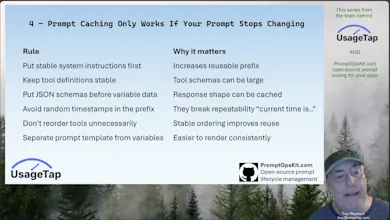
4. Accidentally breaking prompt caching
Potential saving: usually modest but worthwhile, often 5 to 15% on input-heavy repeated prompts. We discuss how to keep stable input at the top and changing context at the bottom of prompts. And why NOT to include the current time in your system instructions!
5. Using high reasoning when the task is simple
Potential saving: often 50%+ on calls where reasoning tokens dominate. Just stop thinking....
6. Running real-time calls that could be batched
Potential saving: up to 50% on eligible background jobs. Unless the user is waiting, send it batch!
No giant framework. No magic “cut your bill by 90%” promise. Just practical engineering habits that matter once people actually start using your AI feature.
Note: I'm no YouTube personality, so please be forgiving of my screen presence and speaking imperfections!
I also show a new open-source project I’m building to encode some of these practices into a team workflow: PromptOpsKit, open-source prompt management for AI apps https://promptopskit.com but ALL of these ideas can be done without any framework or tool.
I’d love feedback from other founders and developers building with LLMs:
Q. Where did your AI costs first start creeping up, free users, retries, context size, background jobs, or something else?
Q. What other ways to reduce LLM application costs should I cover?
Troy