
Launching today

Google's ADK for Go 1.0
A flexible framework for developing & deploying AI agents
3 followers
A flexible framework for developing & deploying AI agents
3 followers
Google's ADK for Go 1.0 is production-ready for AI agents. Native OpenTelemetry tracing, self-healing plugin system, Human-in-the-Loop confirmations, YAML agent config, and Agent2Agent protocol for Go, Java, and Python multi-agent systems.
Google just shipped ADK for Go 1.0 — and it's built for AI agents in production, not just experimentation.
The problem: deploying AI agents at scale requires observability, security guardrails, and extensibility — most frameworks treat these as afterthoughts.
The solution: ADK Go 1.0 ships all three as first-class features, built into the framework from day one.
What stands out:
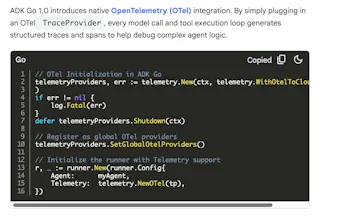
🔍 Native OpenTelemetry integration — every model call and tool execution generates structured traces and spans, visualized in Cloud Trace or any OTel-compatible tool
🔧 Plugin System — inject cross-cutting concerns like logging, security filters, and self-correction without touching agent logic
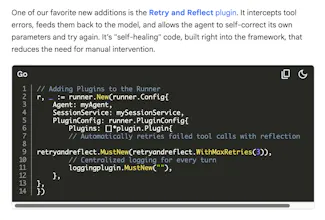
🔁 Retry and Reflect plugin — intercepts tool errors, feeds them back to the model, and self-heals with up to 3 configurable retries
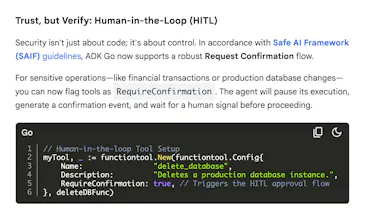
🛑 Human-in-the-Loop confirmations — flag sensitive operations like database deletions or financial transactions with RequireConfirmation, agent pauses and waits for human approval per SAIF guidelines
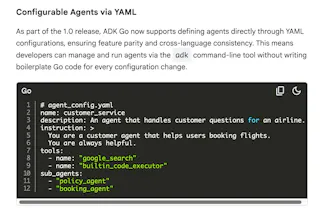
📄 YAML agent configuration — define agents, sub-agents, tools, and instructions without rebuilding the binary
🤝 Agent2Agent (A2A) protocol — seamless communication between Go, Java, and Python agents with automatic event ordering and response aggregation
🔀 SequentialAgents, ParallelAgents, and LoopAgents — flexible orchestration for any workflow pattern
🚀 Deploy anywhere — locally, Vertex AI Agent Engine, Cloud Run, or Docker
Different because ADK is model-agnostic and deployment-agnostic — optimized for Gemini but not locked to it. And unlike experimental agent frameworks, 1.0 means production-grade stability with built-in evaluation, safety patterns, and a rich tool ecosystem.
Perfect for Go developers and engineering teams building production-grade multi-agent systems at scale.