Concilium runs Claude, OpenAI Codex, and OpenCode in parallel on every coding prompt. The responses are then anonymously peer-reviewed by juror models and synthesized into a single, validated answer. Open source, local-first, MIT licensed. CLI and desktop app.
No reviews yetBe the first to leave a review for Concilium
Maker
📌
Hey everyone — I'm Matías, the maker behind Concilium.
I built this because I got tired of my own workflow. Every time I had a non-trivial coding task, I'd paste the same prompt into Claude Code, Codex, and OpenCode, then spend 20 minutes switching between terminals trying to figure out which response was actually best. Sometimes Claude nailed the architecture but missed edge cases. Sometimes Codex had cleaner code but hallucinated an API. There was no way to know without reading everything line by line.
So I thought — what if the models reviewed each other?
That's Concilium. You send one prompt, three agents work in parallel, then juror models anonymously evaluate every response and a chairman synthesizes the best parts into one answer. It's like a code review panel, except the reviewers are also AI and they don't know whose code they're looking at.
A few things I'm proud of:
- It's fully local. Your code never leaves your machine. The only network calls are to the LLM APIs you configure.
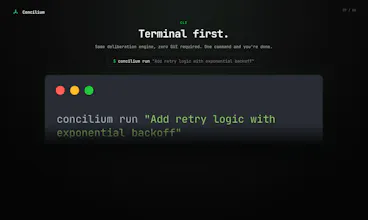
- It works from the terminal. concilium run "your prompt" — that's it. There's also a desktop app if you prefer a GUI.
- It's open source (MIT). You can see exactly how every stage works, fork it, extend it, contribute.
- It actually saves money vs. running models manually, because the juror/synthesis step uses cheaper models to validate expensive ones.
I'd love your feedback. If you try it, open an issue on GitHub — I read every single one.
→ GitHub: github.com/matiasdaloia/concilium
→ Install: npm install -g @concilium/cli