Launching today
Abstraction AI

Abstraction AI

Turn messy conversations into developer-ready specs.

1 follower

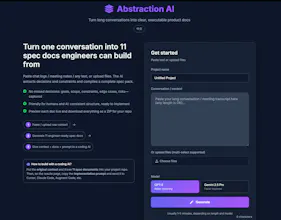
Abstraction AI takes your long, chaotic chats with LLMs and turns them into a complete, beginner-friendly spec: product brief, architecture, data model, and implementation plan. Hand it to any coding agent and get more reliable, less wasteful development runs.
Abstraction AI gallery image
Free
Launch Team
Intercom
Intercom
Startups get 90% off Intercom + 1 year of Fin AI Agent free
Promoted

What do you think? …

Charlie Cheng
Maker
📌
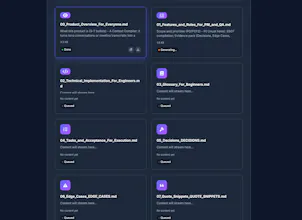
Hi Product Hunt 👋 When I build a new project with AI, my process usually starts the same way: I talk to ChatGPT or another LLM for dozens of turns, explore ideas, change my mind, and slowly converge on “what I actually want”. Then I used to take that huge, messy chat log and throw it into a coding agent like Claude Code or Cursor and say: “Please build the system based on all this context.” It sounds reasonable, but in practice: - The context is noisy and self-contradictory. - The agent is not sure which version of the idea is final. - Many people do not know what a “complete” system spec should look like, so critical details are missing. Abstraction AI is my attempt to fix that middle step. Instead of going straight from “vibes” to “code”, it adds one deliberate layer: 👉 Turn long, messy context into a clear, structured spec. You paste in: - long LLM conversations - meeting transcripts - your own free-form description Abstraction AI outputs: - a high-level product overview - user stories and core flows - system architecture and components - data model and API sketches - constraints and non-functional requirements - a step-by-step implementation plan and ready-to-use prompts for coding agents The design goal is: - friendly enough for non-technical founders to read and edit, and - structured enough that coding agents can follow it like a checklist. In a sense, it borrows ideas from model training: make the objective and evaluation very clear, then let the optimizer (your coding agent) iterate inside those boundaries instead of guessing. I originally built Abstraction AI using an AI coding agent itself. My next project, which is much more complex, is now built on top of the specs generated by this tool, and the development has been surprisingly smooth and cost-efficient. I would love feedback on: - what parts of the spec format feel most useful, - what would make this safer for teams and production use, - and how you currently bridge the gap between “idea” and “spec” when working with AI. Thank you for checking it out, and I hope Abstraction AI can save you some time, money, and frustration on your next build. 🙏