Launching today
ARIA

ARIA

ITSM Helpdesk Bayesian Keppler-Tregoe AI Servicedesk

1 follower

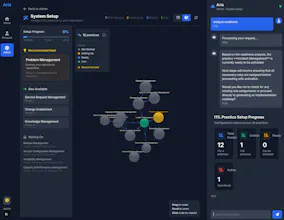
ARIA revolutionizes IT Service Management with conversational AI, context-sensitive canvas, and 3D knowledge graphs. No more endless menus. ANd the best: AI Agent who are using a cognitiv approach with bayesian and Keppler-tregoe
ARIA gallery image
ARIA gallery image
ARIA gallery image
ARIA gallery image
ARIA gallery image
Free
Launch Team
Turbotic Automation AI
Build powerful automations without code. 1 Month Free!
Promoted

What do you think? …

Sven Andreas
Maker
📌
Why AI Agents Won't Save ITSM (And What Will) Every ITSM vendor now has an "AI agent." Most are solving the wrong problem. They're adding conversational interfaces to the same old workflows – chatbots in front of the same forms. That's not innovation. That's automation of dysfunction. The Real Problem Is Cognitive, Not Conversational When an incident occurs, your team must assess what's wrong, consider multiple hypotheses, update understanding as information emerges, and decide under uncertainty. This isn't a workflow problem. It's a reasoning problem. Three Missing Foundations Keppler-Tregoe Analysis – This 60-year-old methodology remains more effective than most "AI-powered root cause analysis." It forces structured thinking: what is vs. what is not, identifying distinctions and changes, testing hypotheses. AI agents that don't guide this reasoning just give you faster garbage. Bayesian Reasoning – Every troubleshooting step should update your confidence in competing hypotheses. Yet most tools treat decisions as binary. Bayesian thinking means reasoning probabilistically about evidence strength, not just following the highest score. UX as Cognitive Architecture – Why toggle between ticket, CMDB, monitoring dashboard, and knowledge base? Each switch costs working memory and increases errors. Good UX means information architecture that matches human cognition, not prettier forms. Security Can't Be an Afterthought Here's what no one talks about: sending incident data to cloud AI services means your most sensitive operational intelligence leaves your network. For many organizations, that's a non-starter. On-premise deployment with local LLMs isn't a "nice to have" – it's fundamental. GDPR compliance, data sovereignty, and security policies demand it. Yet most AI-first tools force cloud dependency because retrofitting on-premise is architecturally impossible. What This Looks Like In ARIA, we built these principles from the ground up. The conversational interface guides structured analysis. The real-time canvas visualizes competing hypotheses as evidence accumulates. The single-pane interface eliminates cognitive overhead. And local LLM deployment keeps your data yours. Most ITSM vendors can't build this way – they're trapped by existing architecture. You can't retrofit structured reasoning onto form submission. You can't add Bayesian probability to binary workflow engines. You can't bolt on-premise AI to cloud-dependent platforms. The Real Question As AI capabilities explode, the question isn't "can our agent write better summaries?" The question is "does our platform help humans think better under pressure while keeping data secure?" Everything else is just faster paperwork. What methodologies do you wish were built into your ITSM tools?